



Since the Federal Council’s decision of 12 June 2026, the date is fixed: on 1 October 2026, the new Transparency Act (TJPG) and the revised Anti-Money Laundering Act enter into force. From then on, companies limited by shares (AG), limited liability companies (GmbH) and other legal entities must report their beneficial owners to a central federal register.
Before a company can report, however, it has to answer one question properly: Who actually is our beneficial owner? The answer is not always as simple as the well-known 25% rule suggests.
The basic rule: control, not just ownership
A beneficial owner is always a natural person, meaning a human being, never a company. A person qualifies if they ultimately control the company. The TJPG recognises three ways of doing so:
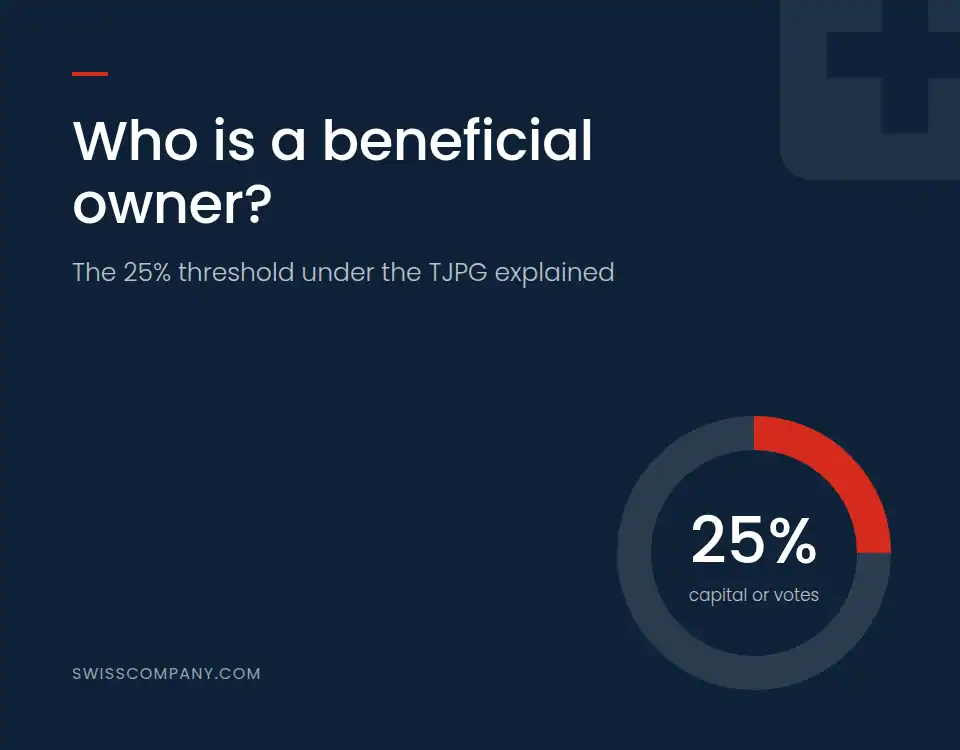
- Direct shareholding: The person holds at least 25% of the capital or votes themselves.
- Indirect shareholding: The person controls the company through one or more intermediate companies.
- Control in another way: The person has significant influence that is not visible from the shareholding.
Important: either capital or votes count. Someone who holds 25% of the votes through voting shares but only 10% of the capital is still a beneficial owner.
Example 1: A typical GmbH
A GmbH has three partners:
| Partner | Share | Beneficial owner? |
|---|---|---|
| Anna | 45% | Yes |
| Marco | 30% | Yes |
| Lukas | 25% | Yes, the threshold is reached |
If Lukas held only 24%, he would not be a beneficial owner, unless he controlled the GmbH in another way. The threshold is at least 25%, not more than 25%.
Example 2: A holding structure
Many entrepreneurs hold their operating company through a holding. Here, the chain must be traced all the way to the person at the end.
- Sandra holds 60% of Muster Holding AG.
- Peter holds 40% of Muster Holding AG.
- Muster Holding AG holds 30% of Muster Operations AG.
For Muster Operations AG: the holding owns more than 25%. Sandra controls the holding by majority and is therefore a beneficial owner of Muster Operations AG. Peter, on the other hand, has no majority in the holding. Through this chain he is not a beneficial owner, even though he mathematically holds 12% of the operating company.
Chains like these are where most mistakes happen in practice. If you work with a holding in Switzerland, map out your structure early.
Example 3: Above the threshold together
Two siblings each hold 20% of an AG. Individually, both are below the threshold. But if they have signed a shareholders’ agreement and always vote together at the general meeting, they are acting in concert. Together they control 40%, and both qualify as beneficial owners.
Control in another way: the case that is often overlooked
Not all control shows up in the share register. The law also covers persons who, for example:
- can appoint or remove the majority of the board of directors or management,
- have a veto right over important decisions,
- can decide on profit distributions.
Such rights may arise from shareholders’ agreements, options, loan agreements or fiduciary arrangements. A nominee who holds shares for a third party is therefore not automatically the beneficial owner. The beneficial owner is the person on whose behalf the nominee acts.
When nobody reaches the threshold
In companies with widely spread ownership, often nobody holds 25%. In that case there is no “empty report”. Instead, the most senior member of the management body is deemed the beneficial owner: for an AG usually the chair of the board of directors, for a GmbH the chair of the management.
Caution: the old register is not enough
Many companies already keep a list of beneficial owners under the Swiss Code of Obligations. The definition in the TJPG, however, is broader, especially because of indirect control and control in another way. Simply copying the old list risks an incomplete report.
Who can see the data?
The Transparency Register is not public. Access is limited to authorities, financial intermediaries and advisors subject to the Anti-Money Laundering Act, and only to the extent they need the information to fulfil their duties.
Prepare now
Reports can only be filed via EasyGov from 1 October 2026. The groundwork, however, can be done today:
- Map the ownership structure down to the natural person.
- Review agreements for voting arrangements, veto rights and fiduciary relationships.
- Collect personal details and ID copies of the persons concerned.
- Decide who in the company is responsible for the report.
A clear introduction to the new obligations, deadlines and process is available at transparenzregister.ch. For a general overview of the legislative package, see our article Transparency Register and the New Anti-Money Laundering Act 2026.
FAQ
Does a GmbH with only one partner have to report?
Yes. Single-member companies are also subject to the TJPG. There are simplifications, however: if the beneficial owner is already registered in the commercial register as a partner or officer, the report can be made via the cantonal commercial register office, and a longer transitional period applies.
Can a company be a beneficial owner?
No. A beneficial owner is always a human being. If a company holds shares, the chain must be followed until the natural person who ultimately exercises control is found.
Who in the company is responsible for the report?
The most senior member of the management body, for an AG usually the chair of the board of directors, for a GmbH the chair of the management. The actual filing may be delegated to other persons or to a service provider.
What happens if a shareholder does not provide the information?
Shareholders are legally obliged to provide the company with the necessary information. If the company still cannot identify the beneficial owner, it must report exactly that, together with all information available to it.
When can reports be filed?
Reports can be filed via EasyGov from 1 October 2026. Existing companies have staggered transitional periods depending on their legal form and structure. Newly founded companies must report within one month of registration.
Would you like your structure reviewed? SWISS COMPANY AG supports you in identifying your beneficial owners and filing the correct report. More about the Swiss Transparency Register
This article is for general information only and does not replace legal advice in individual cases.


