




The general meetings are over and the annual accounts have been approved. For many entrepreneurs, the next question is: how does the company’s profit reach my private account correctly? In Switzerland, the classic route is the dividend. It is, however, subject to clear rules, and a mistake with the withholding tax can be expensive.
What can be distributed?
An AG or GmbH may only pay dividends out of retained earnings or free reserves created for this purpose. Before doing so, the company must allocate to its statutory reserves:
- 5% of the annual profit goes to the statutory retained earnings.
- This applies until statutory retained earnings and statutory capital reserves together reach half of the share capital. For holding companies the limit is 20%.
- Any loss carried forward must be offset first.
Anyone hoping to distribute the full profit in the first good year will quickly hit this limit.
The process in five steps
1. Prepare and audit the annual accounts
The approved annual accounts are the basis. If the company has an auditor, the audit report must be available before profit appropriation is decided.
2. Proposal for the appropriation of profit
The board of directors or management proposes how much is distributed and how much is allocated to reserves.
3. Resolution of the general meeting
The dividend is resolved by the general meeting (AG) or the partners’ meeting (GmbH). Important: record a due date in the minutes. Without an explicit date, the day of the meeting is deemed the due date, and the deadlines start running from that day.
4. Settle the withholding tax
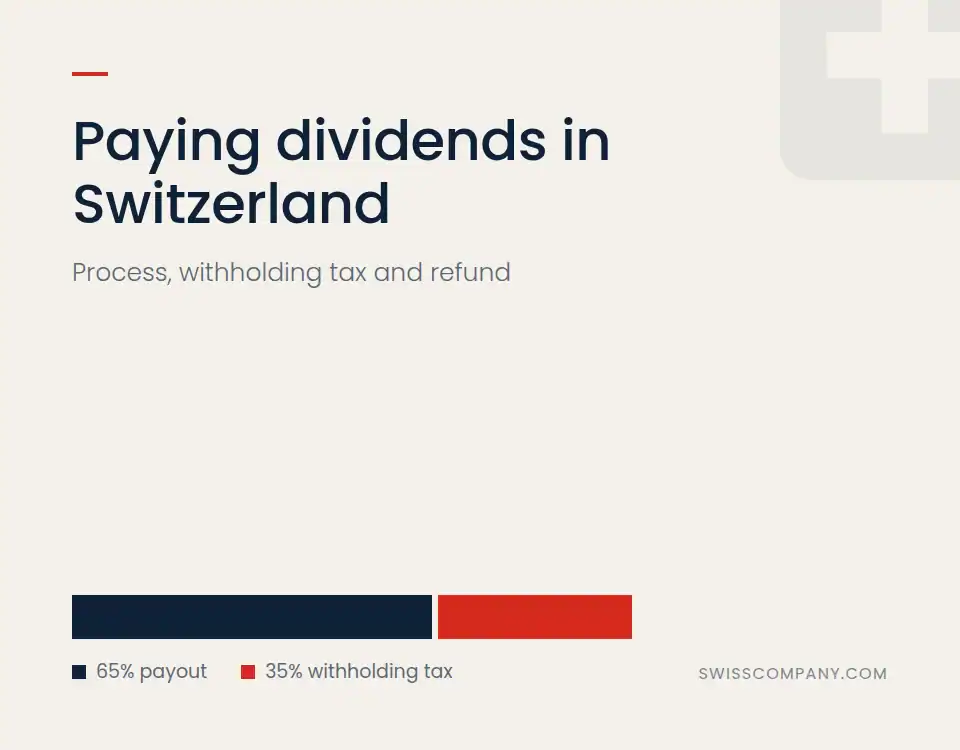
Within 30 days of the due date, the company must declare the dividend to the Swiss Federal Tax Administration (FTA) and pay 35% withholding tax. An AG uses Form 103, a GmbH Form 110.
5. Pay out to the shareholders
65% of the gross dividend is paid out. Each shareholder receives a dividend statement showing the gross amount, the tax deducted and the net amount. This statement is needed for the refund.
Calculation example
Muster GmbH resolves a dividend of CHF 80,000 to its sole partner.
| Item | Amount |
|---|---|
| Gross dividend | CHF 80,000 |
| 35% withholding tax to the FTA | CHF 28,000 |
| Payment to the partner | CHF 52,000 |
The CHF 28,000 is not lost for the partner. Whether and how it can be recovered depends on where they live.
How the withholding tax is recovered
Resident in Switzerland: The dividend is declared in the tax return in the list of securities. The withholding tax is then credited against taxes due or refunded. Anyone who fails to declare the dividend loses the right to a refund.
A Swiss company as recipient: It files a refund claim directly with the FTA.
Resident in Germany: Under the double taxation agreement, Switzerland may only retain 15%. The remaining 20% can be reclaimed via the FTA’s online portal. The claim must be confirmed by the competent German tax office. In the example above, that would be CHF 16,000. More in our article on the Germany–Switzerland double taxation agreement.
Notification procedure: no tax payment for group holdings
If the recipient of the dividend is a company that holds at least 10% of the distributing company, the withholding tax often does not have to be paid at all. Instead, the distribution is merely notified:
- Swiss parent company: Form 106, in addition to the ordinary declaration.
- Foreign parent company: An FTA authorisation is required first. Each distribution is then notified with Form 108. Depending on the double taxation agreement, a residual tax remains or no withholding tax is due at all.
Since February 2026, these notifications can also be submitted digitally via the FTA’s ePortal. For holding structures, the notification procedure is an important liquidity advantage. Learn more about setting up such a structure on our Holding in Switzerland page.
The most common mistakes
Paying net instead of gross: If the full amount is transferred without deduction, the FTA treats the payment as a net amount. The tax is then calculated on a grossed-up amount, and the burden rises well above 35%.
Missing the deadline: Anyone wishing to use the notification procedure must submit the forms on time. When paying the tax, late payment interest applies.
No due date set: Without a date in the minutes, the deadline runs from the day of the meeting, even if the money is paid weeks later.
Forgetting the reserves: A distribution without the correct allocation to reserves breaches the Code of Obligations.
Two alternatives to the ordinary dividend
Interim dividend: Since the 2023 company law reform, a company may also distribute out of current-year profit. This requires interim accounts, which generally must be audited. The withholding tax applies here too, with the same 30-day deadline.
Repayment of capital contribution reserves: If a shareholder contributed money beyond the share capital, for example a share premium at incorporation, this amount can in principle be repaid free of withholding tax. The reserves must, however, have been properly reported to the FTA.
Conclusion
A dividend in Switzerland is not rocket science, but it is a formal process with fixed deadlines. Planning the due date, forms and refund properly means most of the withholding tax comes back, and for Swiss-resident shareholders usually all of it.
FAQ
Does a GmbH with only one partner need to hold a meeting?
A resolution is still required. The sole partner passes it alone and records it in writing. The minutes with amount and due date form the basis for the declaration to the FTA.
Can the dividend be paid later or in instalments?
Yes. The meeting can set a later due date. What matters for the withholding tax, however, is the due date, not the day of the transfer. The tax is owed within 30 days of the due date, even if the money has not yet been paid out.
Salary or dividend: which is cheaper?
It depends on the individual case. A salary is deductible as an expense for the company but is subject to social security contributions. Dividends are not deductible for the company, but for holdings of 10% or more they are only partially taxed at the recipient’s level. The tax authorities also expect managing shareholders to draw an appropriate salary.
Where is the dividend taxed if I live abroad?
In principle in the country of residence. Through the withholding tax, Switzerland only keeps the share it is entitled to under the relevant double taxation agreement. The rest can be reclaimed.
Do I have to file anything with the FTA if no dividend is paid?
In certain cases, yes. A declaration on Form 103 or 110 is required, among others, if total assets exceed CHF 5 million, the company claims a participation deduction or has made use of a double taxation agreement.
Planning a distribution? SWISS COMPANY AG takes care of your annual accounts, profit appropriation and the declaration to the FTA. More about accounting and annual financial statements
This article is for general information only and does not replace tax or legal advice in individual cases.


